
Artificial intelligence has made extraordinary progress in generating answers. Yet across businesses, classrooms, and everyday
life, a new challenge has surfaced: understanding those answers quickly and clearly.
As AI adoption scales,
the limitation is no longer
intelligence it is interpretation.
This is where Rivesa enters the picture, aligning
itself with a larger industry
shift: from text-first AI to
visual intelligence.
Why the AI Industry Is Moving Beyond
Text
For decades,
software has relied on text as the primary way to communicate information. AI followed the same path producing
increasingly sophisticated written outputs.
But humans don’t naturally
think in long passages of text.
They
think in patterns, relationships, images, and structure.
As AI becomes more powerful, text-heavy outputs often slow decision-making instead
of accelerating it. Across
logistics operations, retail environments, classrooms, and daily workflows, users are asking for
clarity, not complexity.
Visual intelligence answers that need.
Rivesa’s Visual-First Approach
to AI
Rivesa is built on a simple
but powerful insight:
AI should show, not just tell.
Instead of delivering intelligence primarily through text, Rivesa focuses
on visual outputs that are
easier to consume, faster to understand, and more intuitive to act on. This
approach reduces cognitive load and shortens the distance between insight and
action.
The result is an AI experience that feels natural
even for users with no technical background.
Why Visual AI Works Across Industries and Age Groups
The shift toward visual
intelligence is not limited to a single
use case.
·
Logistics & B2B operations: Visual outputs enable
faster interpretation of complex systems, flows, and decisions where
clarity directly impacts outcomes.
·
Retail environments: Visual insights support
quicker understanding of trends, inventory, and consumer behavior.
·
Students and colleges: Visual learning improves retention, comprehension, and engagement compared to text-heavy
explanations.
·
Everyday users:
Visual AI lowers
barriers, making intelligence accessible without effort
or expertise.
This universality positions Rivesa not as a niche solution, but as a broad AI interface designed
for how humans naturally process information.
A Larger Shift in How Humans Will Use AI
The AI industry is entering a new phase.
As underlying models become more capable and widely available, the real differentiation will come
from interfaces and experience from how intelligence is delivered, not just
how it is generated.
Visual intelligence represents the next step in this evolution.
Rivesa is not competing
to build louder
or longer answers.
It is focused on making
AI clearer, more usable, and more human.
Looking Ahead
Rivesa’s direction reflects a long-term belief:
the
future of AI will belong
to systems that are easy to understand, easy to trust,
and easy to act on.
As organizations and individuals alike
seek faster clarity
in an increasingly data-rich world,
the shift from text AI to
visual intelligence is becoming inevitable.
Rivesa is building for that future.
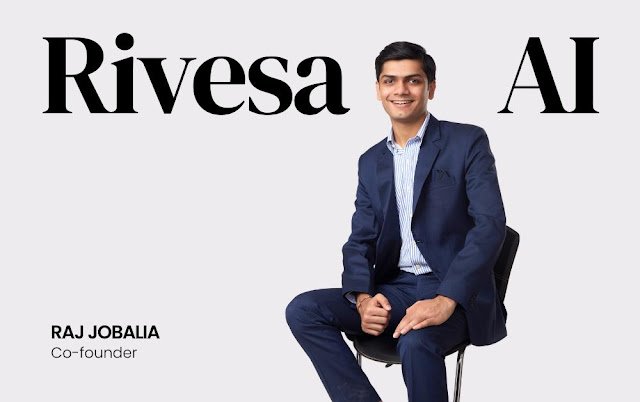
As Raj Jobalia
often puts it, “The future of AI isn’t about producing more information it’s about
producing more understanding.”
His belief is rooted
in a simple human truth:
people don’t connect
with intelligence through
volume or complexity, but through clarity.
Raj envisions a world where AI feels less like software and more
like intuition
where insights are seen, not searched for; where decisions emerge visually, not
buried inside text; and where AI adapts to human cognition instead of forcing
humans to adapt to machines. This philosophy is what drives Rivesa’s
long-term vision: to make visual
intelligence the most natural,
trusted, and universal way humans interact with AI across businesses,
classrooms, and everyday life.