
Delhi, India — [11 February 2026] : As
artificial intelligence rapidly enters education systems worldwide, a critical
question remains unanswered: how are teachers actually using AI in real
classrooms?Today, TeachBetter.ai released a landmark research report, “How Teachers Are Using AI to Transform
Education,” highlighting top 10 teacher-led use cases of AI, alongside the
launch of TeachBetter.ai Version 4.0, introducing a powerful Live
Quiz & Poll Generator to enable real-time assessment, response capture,
and immediate feedback, all done within seconds.
Based on one year of anonymised platform
usage data and qualitative feedback from thousands of educators, the report
marks a shift in the AI-in-education conversation—from speculation to evidence,
and from tools to teaching transformation.
From
Hype to Habit: What the Research Reveals
The report’s most important finding is clear: AI
adoption in education is already happening—but in very specific, teacher-led
ways.
Analysis of TeachBetter.ai
platform usage, spanning over 115,000 resource generations and 30,000
users reveals that teachers are increasingly embedding AI into core
instructional workflows such as lesson planning, assessment, and classroom
preparation. This pattern of usage demonstrates that AI delivers its greatest
value when it is applied to transform teaching through teacher-first platforms,
rather than being used merely to automate or outsource isolated tasks via
generic chatbots.
Top 10 Teacher-Led AI Use Cases Identified in Real Classrooms
Based on analysis of real usage data from the
TeachBetter.ai platform, the research identifies ten recurring AI use cases
that now define how teachers are integrating AI into everyday teaching. Below
are the five most dominant patterns, representing the highest adoption
among active teachers:
● AI-powered
lesson planning has become foundational, with 55% of
teachers using AI to design lessons as part of their regular workflow.
● Assessment
design is scaling rapidly, as 48% of teachers rely on AI to
create quizzes and worksheets efficiently.
● Teaching
is shifting toward visual-first instruction, with 35% of
teachers using AI-generated presentations to explain concepts.
● Academic
and institutional writing is being streamlined, as
32% of teachers use AI for structured documentation and communication.
●
Concepts are increasingly taught through
experiences rather than theory, with 28% of teachers using AI to
design activities and projects.
The full research report details all ten
teacher-led AI use cases. Download Full Report.
“The evidence shows that teachers are not
using AI to replace teaching, but to transform it,” the
report notes. When delivered through teacher-first platforms, AI is helping
classrooms shift away from rote memorisation toward deeper understanding and
real-world application—aligned with the pedagogical direction of India’s NEP
2020.
A key driver of this transformation is time
recovery. Teachers using AI on TeachBetter.ai save an average of 4.7
hours per week, time that is largely reinvested into student mentoring, concept
clarification, and differentiated instruction rather than administrative work.
This finding reframes AI’s value proposition:
“AI’s impact is not in saving time, but in
expanding what teachers can do with it—making teaching transformation possible
at scale.” — Binit Agarwalla, Founder, TeachBetter.ai
TeachBetter.ai
Version 4.0 Launch: Enabling Teachers to Create Online Quizzes in Seconds
This research shows a clear shift: teachers
are moving beyond using AI only for preparation and are beginning to embed it
directly into everyday teaching. TeachBetter.ai Version 4.0 reflects this
transition, prioritising application-driven instruction and real-time
classroom use over simple task automation.
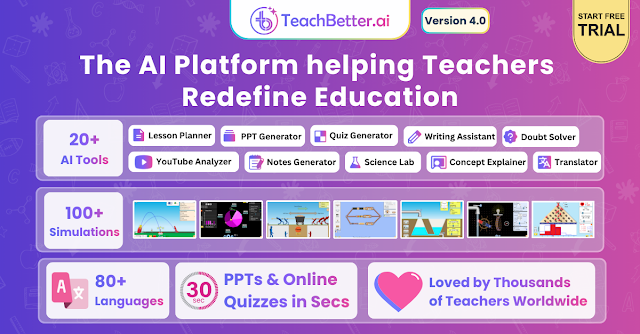
The Live Quiz & Poll Generator
exemplifies this shift—enabling teachers to create online quizzes and polls,
instantly share links, capture responses, auto-grade, and deliver immediate
feedback. What previously took hours can now be done in seconds.
More broadly, TeachBetter.ai functions as quiet
teaching infrastructure, reducing cognitive load while expanding classroom
capability through:
● 20+
AI tools spanning planning, instruction, assessment, creativity, and revision
● 100+
interactive simulations across STEM subjects
● 80+
language support, including Indian languages
● Zero
learning curve, with no prompt engineering or technical
training required
●
A single, integrated platform,
replacing fragmented tools and workflows
Teachers
Speak: What AI Adoption Really Looks Like on the Ground
Across urban and rural schools in India and
globally, teachers describe a consistent shift in how AI platforms like
TeachBetter.ai are becoming part of everyday teaching:
● From
rote practice to conceptual mastery
AI is valued for reducing preparation time while preserving academic
rigor, allowing teachers to focus on deep understanding rather than
memorisation.
“AI helps me generate practice material faster, so I can focus on conceptual
understanding.”
— Dr. M. Gopalakrishnan, Senior Mathematics
Teacher (30+ years)
● Teacher-first
design matters most in resource-constrained settings
Guided AI workflows help schools maintain consistency and rigor even
where time, resources, and technical capacity are limited.
“Our teachers are creating deeper lessons and better assessments with
confidence.”
— Ajithra R, Teacher & School Administrator, Tamil
Nadu
● Curriculum
alignment and time efficiency drive global adoption
Teachers working across international curricula value AI that converts
standards into classroom-ready lessons and assessments.
“TeachBetter.ai is my go-to platform for daily teaching—faster and more
precise.”
— Surya Pratap,
PGT Mathematics Teacher, Bahrain
●
AI succeeds when it becomes dependable
classroom infrastructure
Adoption accelerates when AI removes prompt complexity and reliably
supports planning and assessment as part of daily teaching.
“With TeachBetter.ai, Lesson planning and quizzes now take minutes, not
hours.”
— Kepha Otuke, Teacher, Kisii County, Kenya
From
Potential to Practice: The Path to Mass AI Adoption in Education
The research makes one thing clear: while AI’s
potential in education is evident, mass adoption remains the real challenge.
Teachers continue to face barriers of cost, complexity, and poor alignment with
classroom realities—keeping AI usage stuck at automation rather than true
teaching transformation.
The report frames AI adoption as a
progression—from automation, to enhancement, and ultimately to transformation, where AI enables forms of teaching that were
previously impractical or impossible. The greatest risk, therefore, is not AI
replacing teachers, but educators treating AI only as an automation tool.
This moment represents a critical inflection
point. The next phase of AI adoption in education will be defined not by
novelty, but by scale, simplicity, and sustainability, with
teacher-first design and integrated infrastructure at its core.
Realising this future will require collective
effort across governments, institutions, and technology providers. TeachBetter.ai,
founded by NIT and IIM alumnus Binit
Agarwalla and Vipin
Kumar, is contributing to this shift by building AI as quiet teaching
infrastructure—comprehensive yet simple, affordable, and designed for mass
adoption—helping classrooms move from rote memorization to deeper understanding
and real-world application.
The full research report details all ten
teacher-led AI use cases and other insights around the future of AI in
education. Download Full Report.
Media Contact :
Vipin
Kumar
●
+91 9676352590